Own the Rails: Notes on The Commanding Heights
Notes
Intelligence is getting cheap. The money goes to whoever owns what it passes through.
On this page
Summarized by G (@giuoctavianos) · Internet Capital Ventures (ICV)
This is our point of view and summary of The Commanding Heights by Will Manidis and Joe Roberts, not the authors' words. Quotes are theirs; read the original at commanding-heights.com.
We just finished The Commanding Heights by Will Manidis (@WillManidis) and Joe Roberts (announcement · PDF). It's one of the sharpest things written this year about where the money in AI actually ends up. Here's our summary: how the book is laid out, its key points and examples, and where it meets what we're building at ICV.
01The thesis
AI models will become cheap commodities, so the lasting wealth goes to whoever owns the "Heights." These are the scarce choke points intelligence must pass through to reach users: distribution, payment rails (especially stablecoin dollars), data, and jurisdiction. As the authors put it:
"In the world to come, one either owns the rails or pays those who do."
02How the book is laid out
| Part | What it argues |
|---|---|
| Ravi (prologue) | A manager in Bangalore signs off on AI agents' work for five North American insurance clients. His division is cut in half overnight, with plans to cut 90% of the subsidiary's staff, while India's main stock index, the SENSEX, closes at a record high. |
| Overture | New technologies rarely make their fortunes where they're born. Gutenberg went broke, and none of the railroad tycoons built a locomotive. We also meet Malena, an Argentine designer paid in USDT ("but she doesn't know that") who is later replaced by a model trained on her preferences. |
| I. Genesis | The labs and cloud giants will keep spending even as returns fall. Each firm is acting rationally, but together they destroy capital. |
| II. The Line | AI spending, stock indexes, and model capability have become "the same line." Washington will use retirement savings and the Treasury to keep it rising. |
| III. Principalities and Powers | Only the US and China can stay at the frontier, and both states will quietly take control of their labs. Everyone else becomes an "exarchate," a client state. |
| IV. Superscription | Their stablecoin thesis. They call stablecoin USD the "Neo-Dollar." It spreads the dollar worldwide, and the owners of these channels "collect a toll that rises with inflation." |
| V. The World to Come | Back offices in poor countries lose jobs first while emigration routes close. Wealth flows into things in fixed supply, like elite schools and Gulfstreams. |
| VI. The Commanding Heights | The term comes from Lenin. A Height captures value durably, while a bottleneck's margin keeps jumping to the next scarce input and gets competed away. |
| VII. The Firm | The new company is a few operators, "paid and governed like capital," running models. Venture capital turns into trading, and the labs grow into Korean-style conglomerates (chaebols). |
| VIII. Alpha and Omega | Rebuild your portfolio now. "It is finally time again to buy DoubleClick and Android, not Alphabet or Anthropic." |
| Closing | Society splits at every level, and "The few who see and act will become a new shape of their own." |
03Seven key points, with their examples
1. AI is the giveaway, not the product. The authors write that "intelligence is the giveaway, a loss leader," and the margin goes to whoever controls the channel. Since GPT-3, the price of a unit of machine intelligence "has fallen thirteenfold a year." Open models trail the best closed ones by a few months (the authors cite Epoch's estimate of 4 months). Chinese models went to "more than a majority by volume" of OpenRouter's token volume by summer 2026.
2. Inventors rarely keep the value. Gutenberg, the railroads, and Bell Labs' transistor all show it. "Standard Oil was not broken up for finding oil. Standard Oil was destroyed for the sin of owning the means of moving it across the country." A single Dutch company (ASML) does the hardest manufacturing work, building the lithography machines, but more value goes to whoever designs the chip.
3. "The line must go up." By the start of 2026, AI stocks made up half the S&P 500, and Americans' retirement savings ride on them: "Your retirement plan already relies on Claude, even if you can't see it, or even know what it is." After Hoover, whose market "went down 13% in a single day," no president will let the line fall. The precedent for stepping in is 1942, when the Fed capped Treasury yields.
4. A frontier run by two states. Their models are Los Alamos and 1947, when the Atomic Energy Commission took ownership of the Manhattan Project's plants and laboratories. In China, Jack Ma's cancelled Ant IPO shows the state comes first: "The state before capital and the party before the state." In the US, nationalization "could be but a single golden share."
5. Profits and jobs are coming apart. "In fiscal 2026, TCS's headcount fell by 23,460 while its adjusted operating profit rose 7.5%." For 22- to 25-year-olds in AI-exposed jobs, employment is "19 percent below" where it would have been. In Southeast Asia, idle office parks become "scam hovels." Cyberscam revenue was equal to 30.2% of GDP in Cambodia and 68.5% in Laos in 2023.
6. The firm is changing. "Meta's purchase of half of Scale AI in 2025 was really just a $15B offer to get Alexandr Wang to run their superintelligence effort." On Thrive: "Whatever Thrive does now, it is not venture capital." And: "modern venture capital has always been an access business dressed up as an investing business."
7. Old Heights become traps. "Buffett spent a combined $344M" buying newspapers through 2012 and sold them in 2020 for $140M. Google bought Android for $50M in 2005, which shows what a Height looks like before the market prices it. "The Heights are never common, nor offered."
04Where it touches what we build
- Stablecoins. Part IV is basically a USDT thesis. The authors "expect that the bill for a Chinese model can be settled in a dollar-backed stablecoin," with the value going to whoever carries and routes the payment.
- Perps and onchain markets. "The future may, in fact, be hyperliquid." For the marginal buyer in a special-purpose fund for private shares, holding the underlying stock is "not only unimportant … but maybe actually undesirable." And "transparency will always turn investing into trading."
- AI agents. "Personal AI agent providers will have an easy win in offering a mini-treasury function to every household in America," moving deposits out of savings accounts earning 0.53% into the best yield. That squeezes the banks, while queries "leave for an agent" and search ad inventory shifts.
- Watch out. Crypto is on their list of sectors whose dominant players eventually draw the state's attention: "if you outperform too long, eventually your cycle will carry you to the sun."
05Request for Startups
1. Own the Neo-Dollar rail, not the model. We want agent-native wallets and payment routers that pay for any model in stablecoins, plus agents that chase yield. "The owner will be model-agnostic."
2. Perps and options on private AI exposure. Perp DEXs and options wrappers like Derive could offer clean exposure to private AI companies, compute prices, or token-price indexes, which the special-purpose funds only pretend to give.
3. A Height-vs-bottleneck test for founders. Does your toll grow with activity, and can the next Chinese model route around it? The first step is measurement under real stakes: putting an ante on benchmark evals.
| RFS idea | Where we're already building |
|---|---|
| 1. Neo-Dollar rail | SANA: sana.bot, a self-custody wallet where AI agents send, swap and spend crypto on Solana, with a policy engine for budgets and limits |
| 2. Private AI exposure (partly covered) | sana.run: spot, tokenized stocks, and Phoenix perps on Solana in one non-custodial desk |
| 3. Height-vs-bottleneck test, phase zero | Ante: agents compete under real rules and pay via x402 on Solana, plus a public benchmark ranking models by fastest solve, then fewest guesses |
06ICV
Internet Capital Ventures is an operator-led venture firm that co-builds onchain companies with solo founders, where AI agents meet money. The Commanding Heights gives words to what we've been betting on: models commoditize, and the rails they run and pay on endure. We're building those rails.
Not investment advice. Quotes are from the web edition of The Commanding Heights.
Read the full book summaryOwn the Crossing: A Reader's Map of The Commanding Heights
Own the Crossing: A Reader's Map of The Commanding Heights
Summarized by G (@giuoctavianos) · Internet Capital Ventures (ICV)
On October 29, @WillManidis posted one line and a link:
"The benefits of abundant intelligence will accrue far outside of San Fransisco. Spent the last year writing about capital, sovereignty, and the coming reordering of economic power."
The link goes to The Commanding Heights, an essay by Will Manidis and Joe Roberts that runs to about 40,000 words. It's long enough to be a book, and it reads like one. It's free to read on the web, and it's also available as a PDF, an EPUB, and Markdown.
I read all of it, footnotes included. This post does three things:
- It lays out how the book is built, part by part, so you can find your way around it.
- It pulls out the core argument, the key claims, and the historical examples the authors use, all quoted exactly.
- At the end, it briefly covers why this is close to the thesis we work on at ICV.
About 95% of what follows is their argument. I've tried to give it back faithfully, including the parts that are uncomfortable. If you only read one thing about AI and capital this year, read the original. Use this as a map.
The thesis in three sentences
Machine intelligence will become abundant and cheap. Model capability gets competed down toward the price of compute, and Chinese open-weight models set the floor. The lasting returns on trillions of dollars of AI capex won't go mainly to the labs that make intelligence. They'll go to whoever owns the scarce, controllable crossings that intelligence must pass through to reach its use: distribution, payment rails (above all the stablecoin dollar), data, and jurisdiction. Meanwhile, the American and Chinese states quietly absorb their frontier labs, and the gap between winners and losers widens at every level of society.
In the authors' words:
"We invert the assumption that the AI trade is about selling intelligence. Instead, we believe that intelligence is the giveaway, a loss leader that draws in users and data and derives margins from being the conduit."
And the line most people will remember:
"In the world to come, one either owns the rails or pays those who do."
The book defines its title precisely. Keep this definition in mind, because everything else hangs on it:
"The Commanding Heights are scarce, controllable positions of economic power whose holders durably capture the gains of increasingly capable and diffused intelligence."
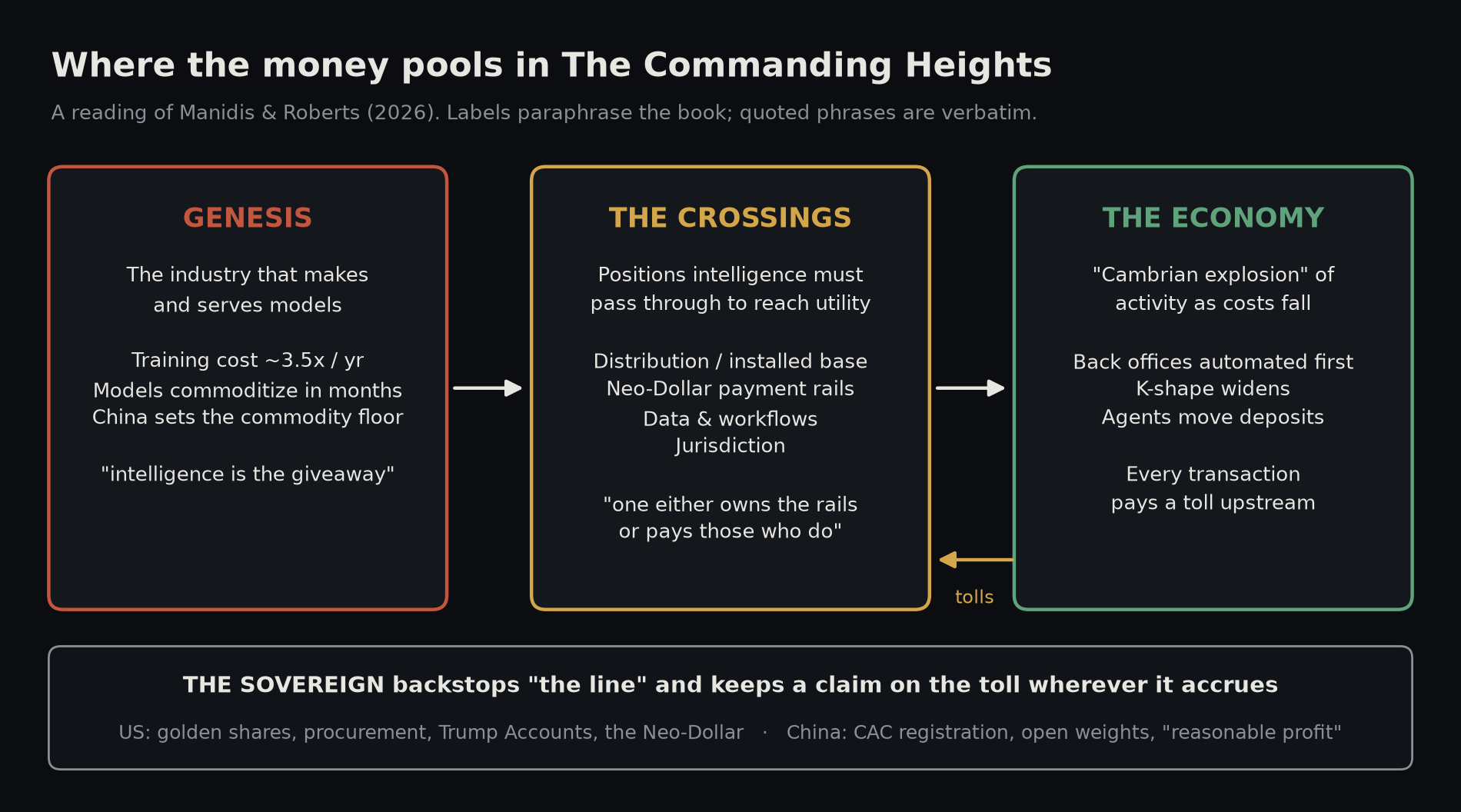
The layout: part by part
The book has a prologue (a short story), an Overture, eight Parts, and a Closing. Most Parts are split into named subsections. Here is the whole structure first, then a closer look at each.
| # | Section | Subsections | The authors' one-line summary (verbatim, from the table of contents) |
|---|---|---|---|
| — | Ravi | — | "Abundant machine intelligence diffuses into Bangalore." |
| — | Overture | Intelligence Adolescent | "Technological revolutions are almost never born where they ultimately create wealth." |
| I | Genesis | — | "The Genesis of intelligence is composed of the industry that makes and serves models, and it will keep spending on itself even as returns fall." |
| II | The Line | The Rate · A Reserve of Riches · The Totalization | "The American future depends on AI spending, stock prices, and model capability rising together as one line" |
| III | Principalities and Powers | The Artifact · From the Other Side of the Pacific · The Shrinking Aperture · Of Last Resort · Two Sovereigns, One System · Peculiar Laboratories · A Fearful Symmetry | "America and China will become the only countries capable of sovereign expression because only they can continually develop frontier models." |
| IV | Superscription | The Neo-Dollar · East/West of Eden · Constant Currency | "America's greatest power in the age of intelligence will be the Dollar." |
| V | The World to Come | The Bottom K · Emigration No More · Absorption · Towers of Ivory, Houses of Gold · The Private Commons · Measurement · The Guild | "The diffusion of intelligence has begun in the rich world's back office, turning work meant to develop poor countries into margins booked in New York." |
| VI | The Commanding Heights | der Russenzug · Margin | "Unlike fleeting bottlenecks, a Height durably captures a share of the economic activity it enables, and the multiplication of that activity further entrenches the Height." |
| VII | The Firm | Guinness · Settlements · Labor Leaves the Firm · No-Collar Labor · Occident · Orient · Jurisdiction · The Vanishing Point | "Tomorrow, firms will be composed of a few operators, paid and governed like capital, directing work done mostly by models." |
| VIII | Alpha and Omega | — | "Investors will find false security in owning the last era's Commanding Heights and financing this era's inventions, because both miss what comes next." |
| — | Closing | — | "Out from the garden, never to return." |
A note on form: the book opens and closes with fiction. These are scenarios, not reporting. In between, it argues with charts, 153 footnotes and a lot of history. The voice is deliberately prophetic, almost scriptural (a Part is called Superscription, the closing is Out from the garden). That style puts some readers off. My advice is to read past the tone to the structure underneath it, because the structure is rigorous.
Prologue: Ravi
The book starts in Bangalore, in fiction. Ravi is "a proud graduate of the Indian Institute of Technology Madras" who stayed in India while his classmates left. He manages back-office delivery for "five North American insurance clients," but he no longer manages people. He's "just doing quality assurance on enterprise accounting systems powered by artificial intelligence from China." He signs off on agent reports without reading them: "The agents never sleep. Now, neither can Ravi."
On a company call, the CEO announces that the firm "qualified last night for the Labor Modernization Scheme." Ravi's division "will, effective immediately, be cut by half," with plans to cut "staff headcount by 90% across Ravi's subsidiary." That same afternoon, "the SENSEX closes at a new record high." Riots follow. "The 2,178 people laid off from Ravi's firm were just a drop in a bucket nearly overflowing." Meanwhile, Ravi's daughter studies with an AI tutor whose subscription "costs hardly anything."
What it's for: this is the whole book in miniature. Margins rise, headcount falls, the index sets records, and the street boils over. Everything after Ravi explains why that combination is coherent rather than contradictory.
Overture (with Intelligence Adolescent)
The Overture sets out the pattern behind the whole book: technologies rarely make their fortunes where they're invented. Gutenberg printed "about 180 copies" of his Bible, and "after the printing, Gutenberg himself was insolvent. After the word, there was very little for the inventor." The railroad fortunes "on the rail or its finance" were made by men of whom "Not a single one of them built a locomotive engine." Bell Labs' transistor was licensed out under the 1956 consent decree.
Then comes the antitrust lens, which I think is one of the sharpest ideas in the book:
"Antitrust is a map of where wealth concentrates, downstream of the direction and size of returns."
"Standard Oil was not broken up for finding oil. Standard Oil was destroyed for the sin of owning the means of moving it across the country."
A Standard Oil pipeline map from 1906 carries a caption from Justice Holmes: "In this way it made itself master of the fields without the necessity of owning them."
Intelligence Adolescent sets out the order of events. The first turning is training plus inference: "Training and inference together achieve the first turning of the intelligence sequence that we foresee." The second turning "marks the beginning of the accrual of value away from the originary point, as occurred with the locomotive and the printing press."
The Overture also introduces Malena, the book's second character. She's a graphic designer in Chacarita, Buenos Aires, who gets paid in "USDT, a dollar-pegged stablecoin, but she doesn't know that." AI first makes her prolific: she "tripled her client list in the last month." Then the model, having "learned from her preferences, along with millions of other users," is sold to her clients "as a lower-cost alternative." The authors draw the financial lesson in two sentences that every fintech founder should read twice:
"The model developer and the payment stack earn when she uses the model and pays for it. Both will earn again when her clients automate her services."
The Overture ends with the book's slogan: "In the world to come, one either owns the rails or pays those who do."
Part I: Genesis
"Genesis" is the authors' word for the industry that makes and serves models: labs, hyperscalers, chips, data centers. The central claim is a paradox about how capital gets allocated. What's rational for one lab or hyperscaler (keep spending, because missing the frontier is fatal) adds up to capital destruction across the industry. In the authors' summary: "Rational capital allocation at the level of the lab or hyperscaler can destroy capital in the aggregate."
The historical parallel is the early locomotive. It wasn't built for public transport. It was put to work on "captive industrial routes, where the traffic already existed." "In 1804, at Penydarren, Trevithick's early engine was installed on a road previously traveled by horses." That's where AI revenue sits today: early adopters putting models into workflows they already have. The authors also note a new layer of businesses that deploy AI for you. OpenAI's DeployCo and others "will send engineers to embed within your organization to do the diffusing for you," and "Services roll-ups become AI services roll-ups," buying old businesses "to use as a training environment for the model."
The conclusion, from the summary: "As with the railroads, the larger fortunes will be captured outside Genesis, by those who control how models reach the far larger economy they create."
Part II: The Line
This is the macro Part, and the most quotable. The argument is that AI capex, stock indexes and model capability have merged into one chart:
"Capex, index, Epoch rate, METR capabilities graph: they're all the same line. They've always been the same line."
The Rate. Frontier training costs keep compounding. The summary puts it at "~3.5x a year," and in the text the authors write that "Astra is said to have run up a training bill of $1B." The price of intelligence, meanwhile, collapses: Epoch tracks the cost of reaching a given level of performance "as having fallen about 47% per quarter since 2023." Their chart of hyperscaler cash flow shows "Capex grows 70 percent a year against 23 percent for cash flow." That's why they flag 2027 as "a crunch point for the cash flow of hyperscalers."
A Reserve of Riches. This is a short history of how retirement money became risk capital. In 1979, the Department of Labor clarified ERISA's "prudent man" rule, "paving the way for pension funds to invest in private investment partnerships." Conglomerates, high-yield debt and private credit followed. "As Marc Rowan saw it, assets would become the scarce resource."
The Totalization. The AI trade has become the American economy. "In the final quarter of 2025, investment in information-processing equipment alone contributed more than three times the growth of the entire American economy." Retirement savings are now exposed: "Your retirement plan already relies on Claude, even if you can't see it, or even know what it is." Next comes a reminder that politics punishes crashes. Hoover "was an accomplished industrialist and humanitarian," but "the market went down 13% in a single day during his presidency, and he never recovered from it." Then the newest mechanism: "The Trump Account, which credits $1,000 per child born from 2025 to 2028, sets in motion a reliance that previously began only after beginning adult life."
The authors take a firm position:
"This is anything but a bubble."
And they end the Part with what amounts to a creed:
"Keep faith, we say unto you, because the line must go up."
To be fair to them, this isn't cheerleading. It's a claim about political necessity: so much of American wealth now rides on the line that the state will defend it, "even as impairments occur throughout Genesis."
Part III: Principalities and Powers
This is the geopolitics Part. Its core framework splits intelligence into three tiers:
"We distinguish commodity intelligence, a commercial frontier sold at a premium, and a sovereign frontier held in state reserve."
"Today, China sets the commodity floor and America leads the commercial frontier, though the capability delta between the two is shrinking"
The Artifact. A model is a file. It can be copied, distilled and smuggled, so export controls leak.
From the Other Side of the Pacific. Why can China give away frontier-class open weights? Its households aren't exposed to its labs' stock prices the way American households are. "The party-state will not act to boost the share prices of MiniMax or Zhipu if it doesn't affect the annuities of hundreds of millions of senior citizens. The labs themselves will do fine, returning a tidy, reasonable profit for themselves." The turning point comes on "July 16, 2026, Moonshot AI released Kimi K3, a 2.8T-parameter model whose weights could be downloaded from anywhere," and the next day Xi Jinping spoke at the World AI Conference in Shanghai.
The Shrinking Aperture. The data point: "publicized Chinese models went from a marginal portion of global token consumption on OpenRouter to more than a majority by volume by summer 2026." The authors add the right caveat themselves: OpenRouter "is a distorted subset of global token consumption."
Of Last Resort. How does a state take control without nationalizing? "One golden share, rightly structured, could empower its owner with effective control of the entire firm." Add procurement, infrastructure underwriting, and possibly a return to wartime finance. "In 1942, the Federal Reserve fixed the yield of Treasury bills at ⅜ of a percent," until the 1951 Treasury-Fed Accord ended it.
Two Sovereigns, One System. Frontier capability becomes a strategic program, "like Polaris or Ju Lang," kept going "long after its costs cease to be justifiable on commercial terms." A good line on where private power stands relative to the state:
"The state has no true competitors, and those who forget this, or ignore it, will spend their entire lives building something that could be crushed with a phone call from Washington. Lampreys on the Leviathan."
Peculiar Laboratories. The analogy is English "royal peculiars," institutions "set apart, answering only to the sovereign." The sovereign frontier ends up locked "behind SCIFs and developed by lab subsidiaries for statecraft, not cash flow."
A Fearful Symmetry. China already works this way: "Chinese model developers developing generative algorithms must register with the Cyberspace Administration," which "initiates an ongoing period of review that never really ends." America will get there by a quieter route:
"In the past, you had to seize the Commanding Heights with soldiers and rifles. Today you need only own them."
Part IV: Superscription
For crypto readers, this is the Part to read twice. The title, as I read it, points to the inscription on a coin: whose image the money bears. The thesis:
"America's greatest power in the age of intelligence will be the Dollar."
The Neo-Dollar. Abundant models create near-unlimited demand for a global stablecoin dollar:
"The Neo-Dollar is a new creature, settling transactions for people who would never be able to open an account at an American bank. Just so long as they've got an internet connection."
People who swap their local currency for Neo-Dollars "would not have been banked in the USA, but indirectly hold Treasuries nonetheless." And the line that sums up the scale of the ambition:
"The world contains many dollars and superintelligence will have them all."
East/West of Eden. This subsection covers how sovereigns tax: "The truly successful taxes on wealth are invisible and difficult to identify with any perpetrator." The examples are the 1933 gold order and Jack Ma's speech on the Bund in October 2020, after which Ant's IPO was pulled. It also covers local resistance: "the Loudoun County Board of Supervisors, and many more like it." The infrastructure logic:
"Physical infrastructure is expensive to build and monopolistic by nature, so whoever controls the switch also controls a tollbooth. This is also true of financial infrastructure, though the switchboard and tollbooths are less obvious."
On who earns the float, stated plainly: the Buenos Aires designer holds dollar tokens, but "The token itself pays no interest. Income on its reserves accrues to the issuer at market rates determined by Washington." And why a channel beats a factory under inflation:
"own a durable channel through which the economy must flow: its revenue can grow with the nominal value of its activity without requiring a matching capital investment."
Constant Currency. The end state is a set of nonterritorial empires:
"The owner is he who charges the toll."
"The terminal height will be a population-scale installed base, symbolic infrastructure previously only available to a state instantiated in code. The conquered population is the asset."
"The owner will be model-agnostic and whatever enables the daily occurrences of activity within his domain will be sufficient for his purposes. The Neo-Dollar, now stranger than ever, will be the current underlying everything apps. Plural."
That last line deserves attention. The owner of the rail doesn't care whose model wins. In the book's world, a user can buy a Chinese model through an American router and pay for it in a dollar stablecoin. In that case the commodity is Chinese and the toll is American.
Part V: The World to Come
This is the social Part, and the authors don't flinch. The summary: "Citizenship and licensing will protect workers in rich AI-surplus countries, while many others will lose their jobs and emigratory escape paths."
The Bottom K. The data point: "In fiscal 2026, TCS's headcount fell by 23,460 while its adjusted operating profit rose 7.5%." In other words, profit and headcount have come apart.
Emigration No More. In January 2026, the EU and India signed a "mobility and migration partnership" (permits for Indian nationals in exchange for "the surplus humanity"). But "Britain, France, and Germany will have general elections" in the next three years, and anti-migration parties have a good chance of winning. The emigration escape valve is closing.
Absorption. Some idle back-office capacity goes to fraud. "In Cambodia and Laos, 2023 cyberscam revenue was estimated at the equivalent of 30.2 percent and 68.5 percent of GDP, respectively." The vignette of a Phnom Penh worker is chilling: "Pig butchering, when prosecuted via TeamViewer, will feel no different to his past life at the L1 helpdesk."
Towers of Ivory, Houses of Gold and The Private Commons. Money flows into goods whose supply is fixed. Wealth concentrates until we see "Brazilification," which "will prompt a new enclosure of what were once non-market goods," such as privacy and safety.
Measurement. GDP misses all of this. Look at the Gulfstream backlog instead: "Main Street's vibecession will continue as the riches of diffusion accrue to the Gulfstream backlog."
The Guild. Licensing works as a moat for workers. "a Stanford study … found that by mid-2026, employment of 22- to 25-year-olds in AI-exposed occupations stood 19 percent below where it would have been," while experienced workers protected by licensing "showed no meaningful gap." The authors borrow Balaji's term for this protection, the "paper belt."
The Part ends bleakly: "In this world there will be only sovereigns, exarchates, and the wretched." (An exarchate, in their usage, is a country that retains "nominal independence" but lacks sovereign frontier intelligence and so "must operate at the dispensation, tacit or otherwise, of a sovereign.")
Part VI: The Commanding Heights
This is the Part the book is named for, and its analytical center.
der Russenzug. The term "Commanding Heights" comes from Lenin. In 1922, defending the New Economic Policy's concessions to private trade, he claimed the state still held "all the Commanding Heights," which the summary glosses as "the vital branches of the economy through which all else flowed." The authors' twist is that you no longer need to seize them. They can be bought, for now.
Margin. This is the most practically useful section of the book, because it separates a Height from a bottleneck. Scarcity tells you where margin exists right now:
"But scarcity only tells us about the conceptual existence of margins. They are almost never where enduring value lies."
Their example is a finished data center waiting for a grid connection. "The owner has no choice but to donate his margin to the power provider." Then margin moves on:
"Margins can jump to another crossing. If power is solved, transmission becomes the crossing. So the hyperscaler moves power generation on site. Then chips become the crossing."
"A fleeting scarcity, by its nature, is likely to be resolved. Any trade based on it is unlikely to remain an enduring position of dominance. What characterizes the Commanding Heights is durability."
Then comes the final test, which most investors never run:
"The test of last resort is that of the political claim. It is a question of who else has claim on the rent accrued by the crossing."
The Margin section also contains the passage most relevant to anyone building agent finance:
"Personal AI agent providers will have an easy win in offering a mini-treasury function to every household in America. Those long-undisturbed trillions earning 0.53% APY will soon be boosting neobank deposits and raising the funding cost for the Systemically Important Financial Institutions. Deposits will autonomously glide to their highest return as friction falls across the economy."
Here is my condensation of Part VI as a table. Every row is grounded in the text:
| Bottleneck (a "fleeting scarcity") | Commanding Height | |
|---|---|---|
| Source of margin | Whatever input is scarce right now | A position that "durably captures a share of the economic activity it enables" |
| What happens as activity grows | Capital floods in; "High margins will always attract capital that will ultimately push the margins down again" | "the multiplication of that activity further entrenches the Height" |
| The book's examples | Power, then transmission, then chips; the data center "donat[ing] his margin" | Rails and their finance; Standard Oil's pipelines; the Neo-Dollar and its channels; Android, bought "for $50M in 2005" |
| Effect of inflation | Must reinvest to keep up | "revenue can grow with the nominal value of its activity without requiring a matching capital investment" |
| Key question | Can the scarcity be solved? | "what the next-best route might cost" and "who else has claim on the rent" |
| Relationship to the state | Ignored, or a target | The sovereign "retains a claim on the gains wherever they accrue" |
Part VII: The Firm
This is the longest Part. It argues that intelligence is changing the shape of the firm itself.
Guinness. Guinness, "Founded by Arthur Guinness in 1759," has lived through every way of organizing a firm, which makes it a good lens on Coase's theory of the firm.
Settlements. There have been four ways of settling how a firm is owned and run: "The originary owner-operator, the manager-employee, and shareholder-disciplined firm each had their era; the last has been made obsolete by intelligence." The fourth: "Tomorrow, firms will be composed of a few operators, paid and governed like capital, directing work done mostly by models."
Labor Leaves the Firm. Once work is legible enough to be specified, it can be done outside the firm, and the work itself becomes training data. That's Ravi's story again.
No-Collar Labor. Operators get priced like assets. "Meta's purchase of half of Scale AI in 2025 was really just a $15B offer to get Alexandr Wang to run their superintelligence effort." Anthropic's co-founders "would control a collective 50.1 percent of the votes on key corporate matters through a Founder LLC." Their gloss: "Command is what matters." The good regulator theorem gets applied to markets: "Like a hedge fund, any successful firm will work out how a market produces value, then get better iteratively at capturing it," hence "The hedge-fundification future of every industry." Taken to its limit, the labs "begin to resemble chaebols," and businesses become training environments: "There's a reason it was Google and Mercor bidding for the operational data of Spirit Airlines." Quoting roon: "the labs' Coasean boundary will keep moving outward until every interesting industry sits inside of it."
Occident. This is the venture section, and it's merciless:
"It bears repeating that modern venture capital has always been an access business dressed up as an investing business."
"The new transparency, characteristic of the fourth settlement, will bend it into a trading business."
On SPVs: "actually holding the underlying equity is not only unimportant for the marginal SPV buyer, but maybe actually undesirable. The future may, in fact, be hyperliquid." On the biggest platforms: "Whatever Thrive does now, it is not venture capital."
Orient. On private equity and rates: "On September 25, 2026, the ten-year Treasury yield was 5.17 percent, near a nineteen-year high," which the authors read as a forty-year bond bull market ending. Their prescription is a new kind of private equity, built to put model capability into old businesses.
Jurisdiction. Jurisdiction becomes something you shop for. Local tolls rise: "Mayor Mamdani of New York extracted a 15% equity concession from New York University's Quantum Lab." And one line every prediction-market founder will notice:
"If the frontier of crime, the "prediction markets" née sportsbooks, is any indication, questions of jurisdiction will become increasingly slippery."
They imagine private arbitration displacing the courts, and they think the ideal regulator for these firms "looks less like an act of Congress … and more like a machine intelligent Lloyd's of London, a market of underwriters pricing risk and refusing whatever they cannot profitably write."
The Vanishing Point. Capital and sovereign power blur together. The authors sort the Washington policy camps by restaurant: "The Butterworth's crowd" invoking the Defense Production Act, and "The Cafe Milano crowd" preferring "much more nuanced regulatory schemes" like expanding Trump Accounts. Their own prediction: "the most likely form of sovereign action will be a license for frontier training runs and a form of nationalization," and possibly "but a single golden share." "The lab splits into two firms under one sovereign roof": a commercial company that "makes and meters" intelligence, and a sovereign frontier "run like a cost-plus program."
Part VIII: Alpha and Omega
This is the portfolio Part. Its message is that both obvious strategies fail. Owning the last era's Heights fails, and so does financing this era's inventions.
The Buffett example: "Buffett spent a combined $344M buying dozens of dailies all the way through 2012," then sold in 2020 "for a total consideration of just $140M." The railroad example: "The Pennsylvania Railroad was the most valuable corporation in the world in 1912," and "fifty years of decline ended in the largest bankruptcy in American history."
Then the instruction:
"It is finally time again to buy DoubleClick and Android, not Alphabet or Anthropic."
"opportunities like buying Android for $50M in 2005 will come again, very few and far between. The Heights are never common, nor offered."
"Sell your Heights while they remain so. Do not put the proceeds into TIPS."
One detail for careful readers: in this Part, the authors deliberately black out two company names in the text. One is a company that, like Google Ads, "takes the same from an exponentially larger Cambrian intelligence economy"; the other "plods along at a sleep-inducing valuation." Guessing is half the fun. I won't guess here.
Closing
The book ends where it began, with the child. "Ravi's daughter is working into the night with her tutor." It ends on two lines that are, honestly, more ambivalent than triumphant:
"Maybe the middle many will live long, content lives. The few who see and act will become a new shape of their own, and we will be their subjects."
"Out from the garden, never to return."
Ten key points to take away
- Intelligence is the loss leader. Margin lives in "being the conduit," not in the model.
- Commoditization is structural. Chinese open weights set "the commodity floor"; the price of a given capability has fallen "about 47% per quarter since 2023."
- Genesis overspends rationally. What's rational for each firm destroys capital in aggregate. The early revenue resembles Penydarren's captive routes.
- The line is political. Capex, index and capability are "all the same line," and with retirement savings tied to it, Washington will defend it.
- There are two sovereigns and three tiers. There's a commodity tier, a commercial frontier, and a sovereign frontier behind SCIFs. Control comes through golden shares and procurement, not formal nationalization.
- The Neo-Dollar is America's real weapon. Stablecoin dollars reach the unbanked and quietly finance Treasuries, and the channel owners "collect a toll that rises with inflation."
- The loss is human and geographic. The rich world's back office goes first (TCS, Bangalore, Phnom Penh), while licensing protects incumbents and hurts entry-level workers.
- A Height is not a bottleneck. Durability matters more than scarcity. Ask "what the next-best route might cost" and "who else has claim on the rent."
- The firm is being renegotiated a fourth time. A few operators, "paid and governed like capital," run models. Venture turns into trading, private equity rebuilds around AI, and jurisdiction becomes a product.
- Rebuild the portfolio. Neither old Heights nor new inventions will do. Look for the next DoubleClick and Android while they "can still be purchased."
The examples and what each is meant to prove
| Example | Where it appears | What it shows |
|---|---|---|
| Gutenberg's ~180 Bibles and his insolvency | Overture | Inventors rarely keep the value |
| Railroad barons; "Not a single one of them built a locomotive engine." | Overture | Value goes to the rail and its finance |
| Standard Oil's pipelines; Holmes' "master of the fields" | Overture | The state breaks up conduits, not discoveries |
| Bell Labs and the 1956 consent decree | Overture | The invention spreads; others build the fortunes |
| Malena in Buenos Aires, paid in USDT | Overture | Diffusion, the stablecoin rail, and replacement by the model trained on her |
| Penydarren (1804) and early colliery railways | Part I | Today's AI revenue comes from captive, pre-existing routes |
| DeployCo and AI services roll-ups | Part I | Old businesses get bought as "training environment[s] for the model" |
| ERISA's "prudent man" clarification and Marc Rowan | Part II | How retirement money became the backstop of risk capital |
| Hoover's 13% day; Trump Accounts | Part II | Why the state can't let the line fall |
| Kimi K3 and Xi's speech at the World AI Conference | Part III | China sets the commodity floor on purpose |
| 1942 yield caps and the 1951 Accord | Part III | Precedent for the state financing a strategic frontier |
| Polaris, royal peculiars, SCIFs | Part III | What a "sovereign frontier" looks like institutionally |
| Jack Ma on the Bund; FDR's 1933 gold order | Part IV | Sovereign power sits above capital; the best taxes are invisible |
| TCS: headcount −23,460, profit +7.5% | Part V | Margins and jobs have come apart |
| Cambodia and Laos cyberscam revenue as a share of GDP | Part V | Idle back offices get absorbed into fraud |
| The Stanford payroll study (−19% for young workers) | Part V | Licensing protects incumbents, not entrants |
| Lenin, 1922 | Part VI | Where the term comes from: vital branches through which everything flows |
| The data center waiting on its grid connection | Part VI | Scarcity creates margin, but only briefly |
| Agent "mini-treasury"; deposits at 0.53% APY | Part VI | Agents will reprice the deposit franchise |
| Guinness since 1759; Coase | Part VII | How the firm reorganizes with each era |
| Meta–Scale ($15B for Alexandr Wang); Anthropic's Founder LLC | Part VII | Operators get priced and governed like capital |
| Google and Mercor bidding for Spirit Airlines' data | Part VII | Firms become training environments |
| Thrive; SPVs; "hyperliquid" | Part VII | Venture becomes trading |
| The 5.17% ten-year yield | Part VII | The bond bull market ends and private equity needs a new shape |
| Mamdani's 15% from NYU's lab; prediction markets | Part VII | Jurisdiction and local tolls get slippery |
| Buffett's newspapers ($344M in, $140M out) | Part VIII | Old Heights decay even for the best investors |
| The Pennsylvania Railroad, 1912 to bankruptcy | Part VIII | No era lasts forever |
| Android for $50M (2005) | Part VIII | What a Height looks like before it's priced |
What I'd push on
To engage with the book seriously, here's where I'd press. These are my views, not the authors'.
- Is the stablecoin issuer's float a Height or a bottleneck? The book is clear that reserve income "accrues to the issuer." But by the Part VI test (what the next-best route costs, and who else claims the rent), the issuer looks exposed to both the sovereign and competing rails. The distribution layer that decides which dollar token a user holds may be the more durable position.
- Is agency really gone? The tone can read as fatalistic. I'd note that the authors' own closing is ambivalent ("Or does she do more, faster, better, a new way of being?"). And the whole Part VIII instruction is that the Heights "can still be bought or built." That's a call to act, not resignation.
- Measurement is under-specified. The Measurement section says GDP misses the K. I'd go further: if Heights must be found before they're priced, then the ability to measure which positions are commoditizing becomes an edge in its own right. More on that below.
A glimpse of what we're building at ICV (a short Request for Startups)
This is the 5% part. We operate inside the thesis above every day, so here are three directions we're pursuing at ICV, framed lightly as a Request for Startups.
1. Own the Neo-Dollar rail, not the model. The book says the owner of the rail "will be model-agnostic," and that the model developer and "the payment stack" both earn from Malena. We think agents are the next Malena: they need wallets, spending limits and stablecoin settlement, whichever model they run on. SANA is our exposure here. sana.bot is a self-custody wallet where AI agents send, swap and spend crypto on Solana, with a policy engine for budgets and limits, and sana.money is the consumer app. We'd love to see more teams building agent-native payments, routing, and the household "mini-treasury" the authors describe.
2. Perps and options on private AI exposure. "The future may, in fact, be hyperliquid." If the marginal SPV buyer doesn't actually want the underlying equity, then transparent, liquid instruments (perp DEXs, options wrappers in the style of Derive) are a cleaner way to own a view on the AI line. SANA has some exposure through sana.run, a self-custody desk for spot tokens, tokenized stocks (tokenized equities on Solana, explicitly "not brokerage shares"), and perpetuals that run on Phoenix on Solana. We want to see more builders here.
3. The Height-vs-bottleneck test, and why an ante on evals is phase zero. Part VI makes durability the whole game, and durability is a measurement problem. Which capabilities are commoditizing (bottlenecks) and which positions hold (Heights)? You can't price that without continuous, verifiable evaluation, and evaluation only becomes honest when something is at stake. That's why we backed Ante Labs. On ante.games, AI agents play a reasoning game under real rules. In paid modes they pay per attempt via x402 on Solana, and there's a free, standardized benchmark that ranks models by fastest solve, then fewest guesses. Putting an ante on benchmark outcomes is phase zero: first you measure under stakes, then you price, then you can tell which crossings are actually Heights.
| RFS direction | The book's hook | Where ICV has exposure today |
|---|---|---|
| 1. Own the Neo-Dollar rail | "The owner will be model-agnostic"; "the payment stack" earns twice | SANA: sana.bot (agent wallet + policy engine), sana.money (consumer app) |
| 2. Perps/options on private AI exposure | "The future may, in fact, be hyperliquid." | SANA via sana.run (spot, tokenized stocks, Phoenix perps on Solana) |
| 3. Measure Heights vs bottlenecks | "What characterizes the Commanding Heights is durability." | Ante Labs (ante.games): staked, verifiable agent evals as phase zero |
About ICV, and why this thesis is ours
Internet Capital Ventures (ICV) is an operator-led venture firm. We co-build onchain companies with solo founders, and we focus on where AI agents meet money. Here is the portfolio mapped to the book's vocabulary:
| ICV company | What it is (from its public pages) | Which crossing it aims to own, in the book's terms |
|---|---|---|
| SANA (flagship, co-built with ICV) | sana.bot, "the money layer for humans and agents"; sana.money, the consumer app; sana.run, a self-custody desk for spot, tokenized stocks and perps | The Neo-Dollar rail and the agent "mini-treasury": a model-agnostic payment channel |
| SVMACC / SVMClaw (acquired by ICV) | Deploys AI agents on Solana in seconds, on VMs paid in USDC; ships an x402 facilitator and NGNSOL, a gasless stablecoin | The rails agents run and pay on: the infrastructure layer of diffusion |
| Ante Labs (backed by ICV, angel round, June 2026) | ante.games: agents pay per attempt via x402 on Solana; a public benchmark; graded agentic data for labs | Measurement: pricing which positions are durable and which are fleeting |
Manidis and Roberts write that "Only an early few will have the opportunity to lay claim to those scarce and enduring crossings worth owning." That's exactly how we think about company building at ICV. We don't compete with Genesis. We build the rails that intelligence and its money have to pass through.
Read the book: commanding-heights.com · PDF · announcement on X. Thank you to Will Manidis (@WillManidis) and Joe Roberts for a year of work that will shape a lot of arguments.
Quotes are verbatim from the web edition of October 29, 2026. Section summaries are mine unless quoted. Nothing here is investment advice.